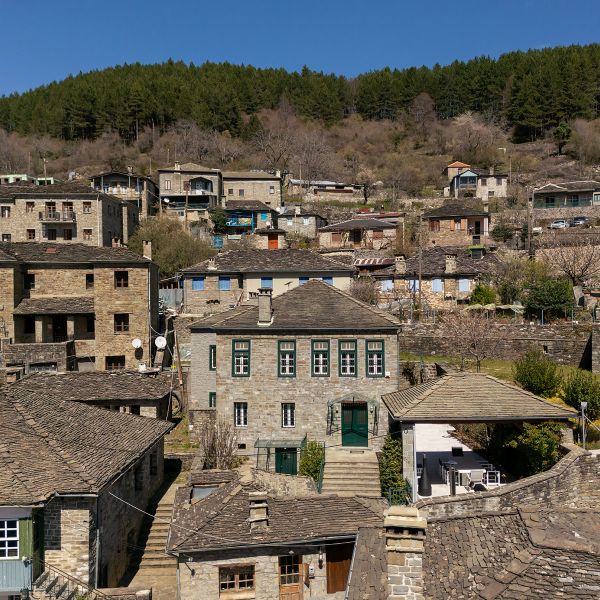
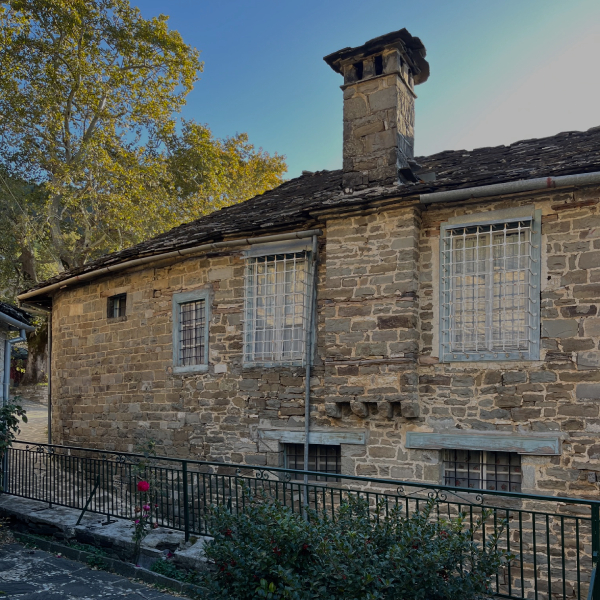
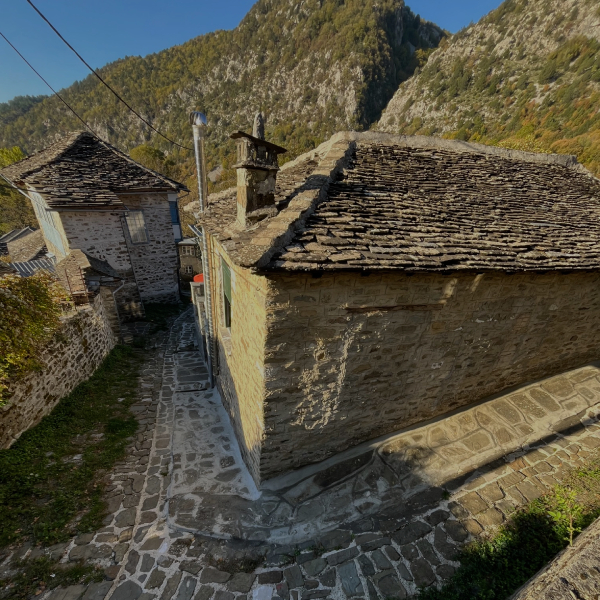
The houses until the 18th century were small rectangular buildings, usually with a single ground floor and with auxiliary rooms in the basement, which were used as stables. Indeed, this seems to be the style of construction of the dwellings at the excavation site of the Molosses near Vitsa. The houses are built of local stone and have slate roofs. The slates are held together without cement, only by the weight of the overlying slabs. The slate roof therefore requires constant maintenance, as it is exposed to heavy snowfall in the winter months. The older type (residence) evolved in the 18th and 19th centuries into more complex forms that ended up in the high-rise mansions of the richest families at the end of the 18th century. Many houses are set back from a walled courtyard or garden. The courtyard door is a structure in itself, covered with slates and connecting the house to the rest of the village.
In addition to the house there are outbuildings, such as a ‘ktikriio’ (kitchen), an outdoor toilet at the furthest point from the kitchen and stables. The main house is built with walls up to a meter thick, often with an inner room with sand for insulation against the cold. The entrance of the house leads into the hall, known as the ‘hayati’, which connects to the neighboring rooms called ‘ontas’ or ‘mandzato’. Originally, and sometimes still today, the hayati was a partially open space in front of the house. This name likely originates from the Persian word “hayat”, a type of Persian garden with pavilions or other structures. The mandzato serves as the main room for the winter months, featuring a fireplace, a ‘tavla’ (table), and seating areas that can also function as beds, called ‘basia’. Opposite the fireplace is a built-in cabinet, the ‘mesandra’. To support its purpose, the mandzato is usually oriented to the south.
A typically wooden staircase leads from the hayati to the entrance of the upper floor, known as the ‘krevatta’, located between the bedrooms. In rare cases, the krevatta opens onto a small balcony with a wooden roof. The ‘glavani’ is a small entryway into the attic. The house’s basement includes cellars and other storage spaces, which can also be used as additional shelter for animals. Few of the old mansions have been preserved, while most have fallen into ruin. In those that remain, the ontas room is the most spacious, featuring a large fireplace and often wall paintings with floral designs. This room served as the main area for welcoming guests.